Chem. 481, Quiz 9, 22 Nov 2019. Name ___________________________________________________

Some thermodynamic and physical properties of C(diamond) and C(graphite) are given in the following table (here standard conditions, designated by the "o" superscript, are 298 K, 1 bar). Remember that 1 bar = 1$\times 10^5$ Pa

quantity C(graphite) C(diamond)
ΔHf(o) (kJ/mol) 0 1.863
So (J/mol·K) 5.6 0.07
CP (J/mol·K) 8.43 6.57
$\bar V$ (cm3) 5.31 3.42

  1. What is $\Delta G$ ($G_{graphite}-G_{diamond}$) at 298? Give your answer in kJ/mol. (3 pts) Since $G=H-TS$,
    $\Delta G = (H_g-H_d)-T(S_g-S_d)$ = –1.863 kJ/mol – 298(5.6–0.07)J/mol=-3.510 kJ/mol

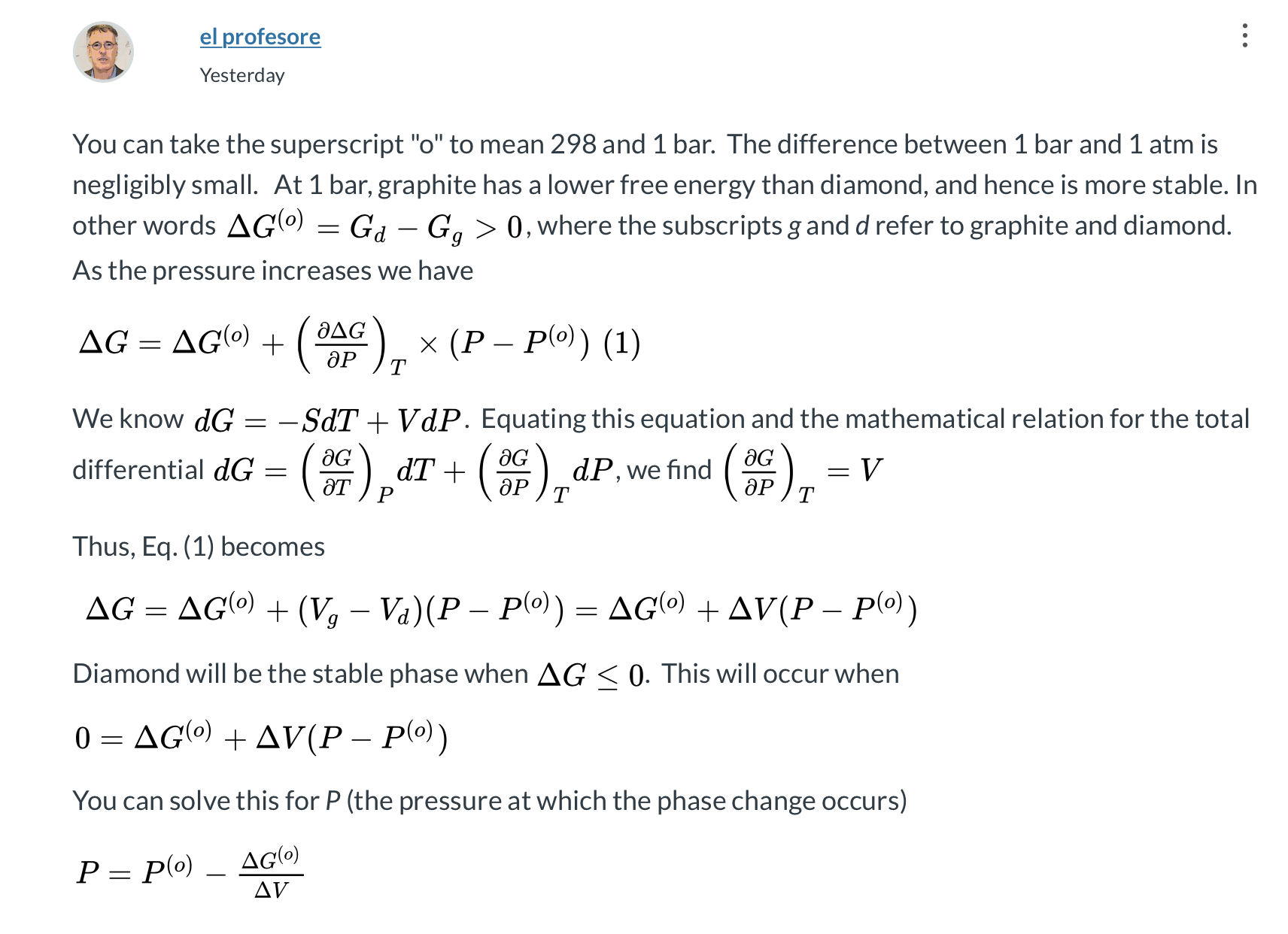
  2. At T=298 K, at what pressure (in bar) will diamond become the more stable form of carbon? (8 pts) Show all work, no credit given for merely stating the answer which you might have remembered from the homework. See the solution on the discussion section on ELMS for November homework (this is reproduced at the end) $$P=P^{(o)}-\frac{\Delta G^{(o)}}{\Delta V}$$ Here $\Delta V = \bar V_g - \bar V_d $= 5.31– 3.42=1.89 cm$^3$. Thus
    P=1$\times 10^5$ Pa + $(3.51\times 10^3/1.89\times 10^{-6}) = 1\times 10^5\,{\rm Pa} + 1.86\times 10^9 {\rm Pa} = 1.86\times 10^4$ bar.

    5 pts for correct derivation of the equation for $P$ in terms of $P^{(o)}$, 2 pts for correct numerical answer. – 1 if decimal place error